Polska Organizacja Odzysku Opakowań S.A.
PARTSLIFE – Corporate UX/UI That Makes Environmental Regulations Actually Readable
UX/UI Designer & Visual Design Lead
- UX/UI Design
- Information Architecture
- Content Design
- Corporate Platform
- Responsive Design
Figma · Adobe Illustrator · Adobe Photoshop
The Problem
Corporate platforms for environmental compliance are rarely readable — this one was no exception.
Polska Organizacja Odzysku Opakowań S.A. needed a platform that combined service offerings, educational content, and a knowledge base for entrepreneurs. The content domain was inherently complex — environmental law, statutory obligations, and acronyms like BDO, ROP, PPWR, and the deposit system all demanded clear navigation and glossaries.
Three compounding issues:
- Complex content domain — environmental regulations, statutory duties, and abbreviations (BDO, ROP, PPWR, deposit system) needed clear navigation and terminology glossaries
- Multiple entry paths — some users came for services (e.g. product fee), others for specific answers in the knowledge base or educational articles
- Diverse user personas — company boards, operations departments, environmental specialists, and automotive workshops — each with different needs and vocabulary levels
The Solution
I designed a dual-track information architecture so users could instantly choose their path: "I need a service" or "I need information."
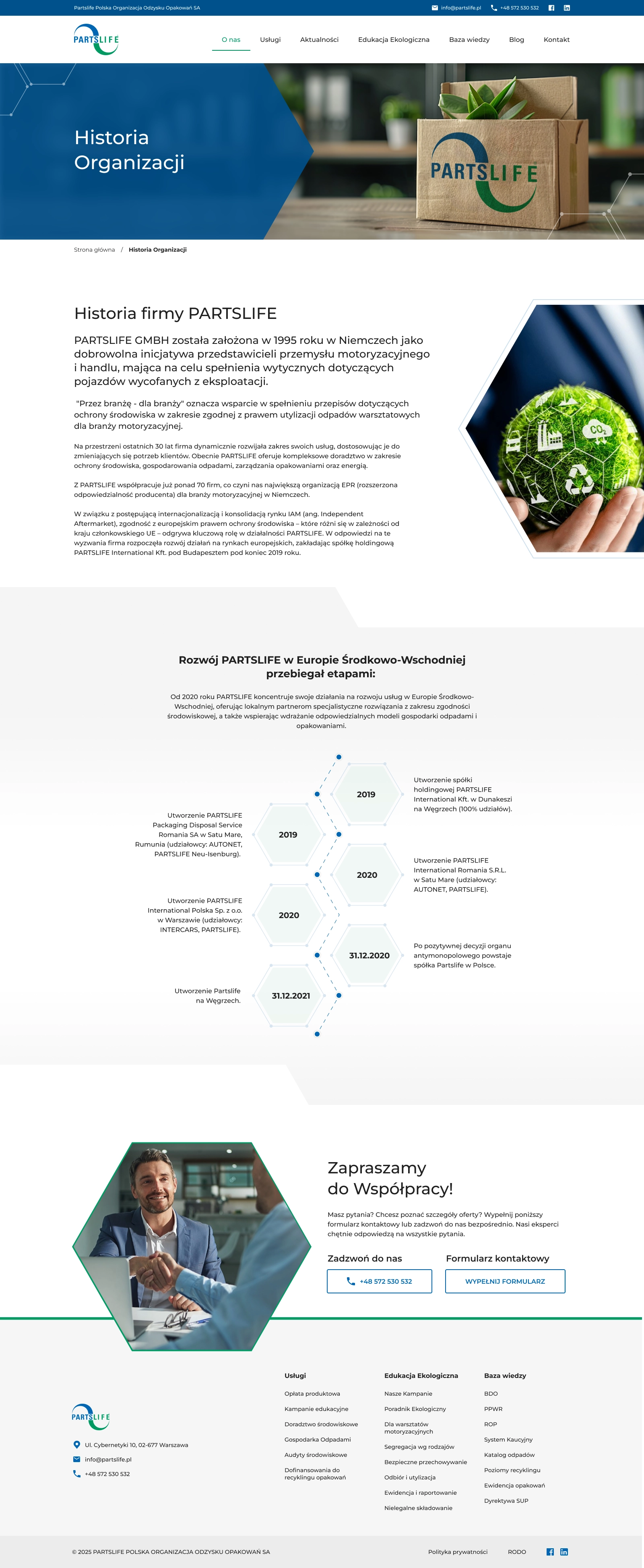
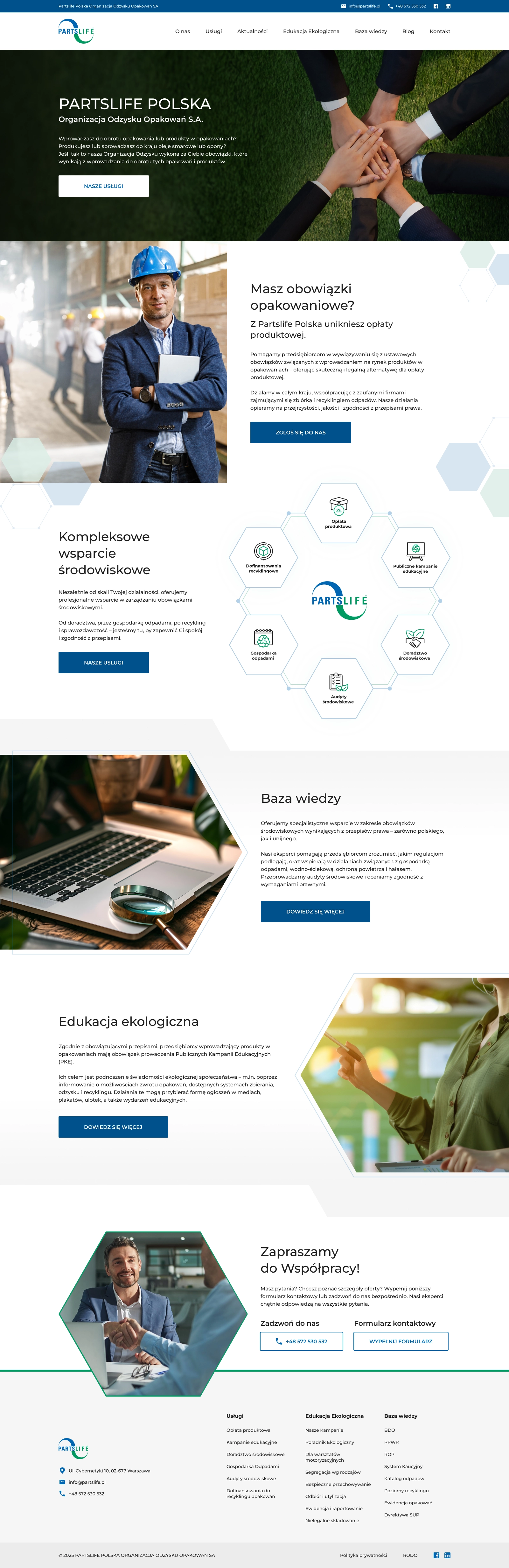
Dual-track information architecture — parallel paths for Services (product fee, co-funding, waste management, audits, consulting, PKE) and Knowledge/Education (knowledge base, guides, industry sections). Users quickly choose: "I'm commissioning" or "I'm learning."
Navigation & exploration patterns — clear service entries from the homepage, shortcuts to core topics (BDO, ROP, PPWR, deposit system, waste catalogue), breadcrumbs, and "Contact us" CTAs at key decision points.
Decision-support modules — interface designed around interactive worksheets and contact forms so users can move from reading to action (inquiry/offer) without friction.
Visual layer — restrained typography, card grids for services and topics, iconography that organizes terminology, and visual emphasis on calls-to-action and expert sections.
Responsive & mobile-first — designed for reading longer content and quick section jumps (sticky navigation, visible shortcuts) on mobile.
Process & Validation
- Figma — mapped information architecture, low/high-fi wireframes, prototyped key user paths
- Illustrator / Photoshop — iconography, illustrative compositions, image processing
- Content design workshops — collaborated on standardizing service names and knowledge base topics; prioritized seasonal themes (e.g. legislative changes)
- Quick-orientation testing — validated whether users could find answers in under 3 clicks: "Am I obligated?", "How do I avoid the product fee?", "Where do I commission PKE?"
Results
- Clearer service entry points — product fee, co-funding, PKE, waste management, audits, and consulting are now reachable without wandering between sections; faster conversion to contact
- Lower comprehension barrier for regulations — clear labels, shortcuts to topics (BDO, ROP, PPWR, deposit system), educational sections and industry guides including automotive workshops
- Shorter content-to-action path — users move from articles and education directly to forms, phone, or interactive worksheets, supporting leads and offer inquiries
This project was delivered on behalf of Webgravity.pl.
Project Images